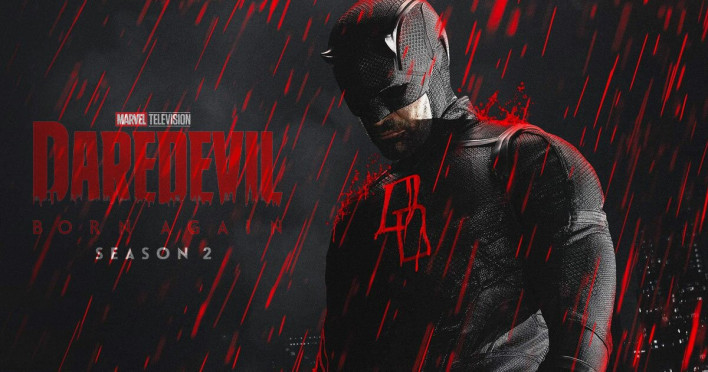
Since the launch of Disney+, Marvel has churned out a massive volume of content. While it released some high-quality works like WandaVision and Loki, the studio eventually faced a crisis of confidence due to a decline in overall quality and audience fatigue. This led to a period of adjustment, characterized by a reduction in content output.
In 2024, the Marvel Cinematic Universe (MCU) released only one film, Deadpool & Wolverine, and the TV series lineup was limited to Agatha All Along and Echo, both of which were well-received. The following year saw a similarly sparse schedule. While the individual series for Ironheart—a character whose portrayal in films had drawn criticism—left some feeling that the TV series were still struggling to find their footing, there was one clear success: the arrival of Daredevil: Born Again.
After reclaiming the rights to the characters from the Netflix-produced Defenders saga (Daredevil, Jessica Jones, Luke Cage, Iron Fist) and The Punisher, Disney spent a long time preparing Daredevil: Born Again. Released in 2025, the series effectively functions as a fourth season of the Netflix show, carrying over the established narrative and characterizations. It acts as if the appearances of Daredevil in She-Hulk: Attorney at Law or Kingpin in Hawkeye and Echo were merely versions of those characters tailored to those specific projects.
Of course, the development process was not without its hurdles, including the replacement of the showrunner—who holds creative control over the story—changes to the initial 18-episode structure, and production delays due to strikes. While Season 1 captured the series’ signature mature tone and character continuity, these production shifts resulted in some unevenness. Consequently, Born Again Season 2, which starts with a clear purpose, focused narrative, and fully realized conflict, concluded as a much more polished and cohesive work. With the upcoming short film The Punisher: One Last Kill and the teased appearance of the Punisher in Spider-Man: Brand New Day, the series has significantly raised expectations for the future of Marvel.
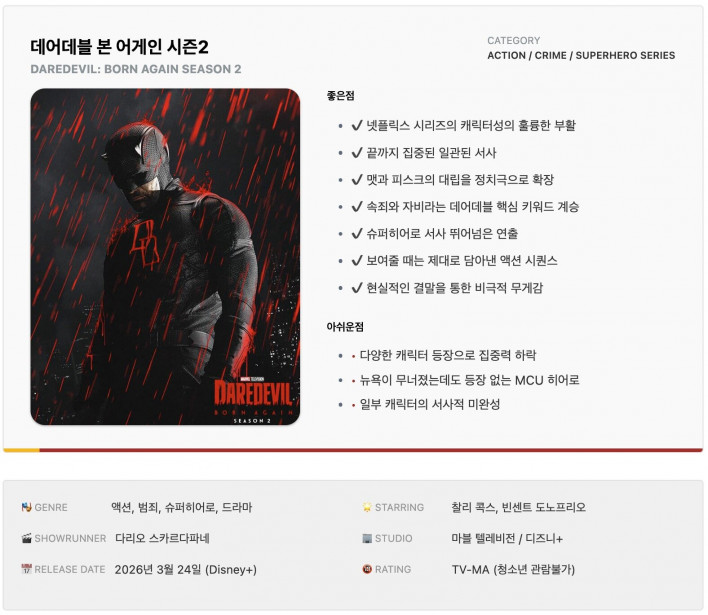
!
This article contains story spoilers. Please proceed with caution.
The greatest appeal of Daredevil: Born Again Season 2 lies in its establishment of character, which remained a point of contention despite the show’s many accolades. The foundation for Matt Murdock and Daredevil had already been built through the numerous Defenders-related series on Netflix. However, to pull these characters into a new conflict, Marvel began Born Again with the death of Foggy Nelson, Matt’s best friend and anchor. Matt then sets out to intentionally kill Poindexter (Bullseye), who was responsible for Foggy’s death.
Although Poindexter luckily survives, the attack was clearly intended to be fatal, and Matt acted with clear murderous intent. This act meant that Murdock could no longer function as Daredevil. The name ‘Daredevil’ was originally a nickname given to him by criminals. Matt, a devout Catholic, adopted it, embracing the irony of a devil-clad figure performing good deeds. Thus, when the logic behind his final act of self-defense—the belief that he was a ‘good person’—collapsed, Matt could no longer accept the Daredevil persona.
This story, which could have been structurally perfect, should have been attempted in Season 1. The death of Foggy, Matt giving up on being Daredevil, and Fisk exercising power as mayor—these elements felt disjointed within the show. Due to the showrunner change, shifts in tone, and extensive reshoots, the narrative felt scattered in the middle of the season. Compared to the newly crafted first episode and the latter half of the season, the middle episodes show traces of new directions being layered over existing footage.
Season 2 avoids these production flaws, driving the story forward through clear opposition and conflict. Matt wants to see Wilson Fisk (Kingpin) justly punished under the law, while Fisk, who genuinely believes he is building a better New York, purges the Daredevil and vigilantes who stand in his way. The conflict between the two is sharply defined. The show expands its scope through a narrative of resistance, depicting how the public reacts and rises up against Fisk’s reign of terror as mayor.
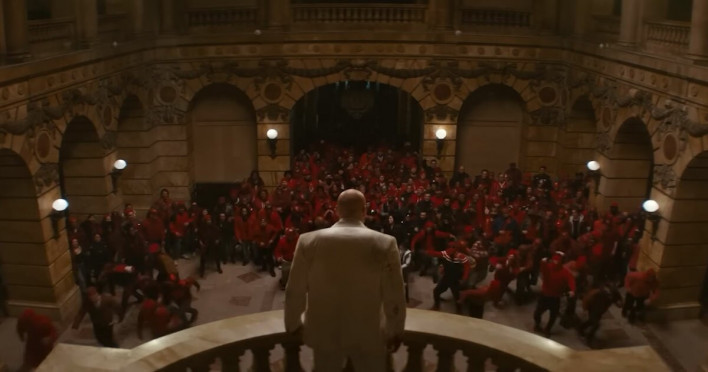
From the first episode, this conflict is laid bare not just between the two men, but within the surrounding environment. Fisk frames Daredevil’s actions as terrorism. The Anti-Vigilante Task Force he established acts as a powerful police force, oppressing people from above. Under Fisk’s fear-based politics, social media is flooded with propaganda videos claiming that crime has vanished and the streets are happy. To them, Daredevil is merely a masked criminal destroying that peace.
In this climate, Daredevil becomes the symbol for resisting citizens. This is why Fisk, despite knowing that Matt Murdock is Daredevil, does not reveal it. If the hero Matt Murdock, who saved himself from Poindexter’s sniper fire, were revealed to be Daredevil, the public’s cohesion would only grow stronger. This decision, born of cold political calculation, clearly illustrates the direction of Season 2.
Fisk represents the legally elected authority, backed by the police and the Anti-Vigilante Task Force. The media is also friendly to Fisk, and many citizens chant his name despite the climate of fear, swayed by his populist rhetoric and actions. Murdock is not just fighting a crime boss; he is fighting the law, the system, public opinion, and the media. Consequently, the legal drama elements of Season 1 feel like mere window dressing, as Season 2 expands the stage into a full-blown political thriller.
Whether intentional or not, international critics have interpreted this as a reflection of the harsh crackdowns and suppression by ICE. For those who saw parallels to reality, it served to make the drama even more immersive than a typical fictional work.
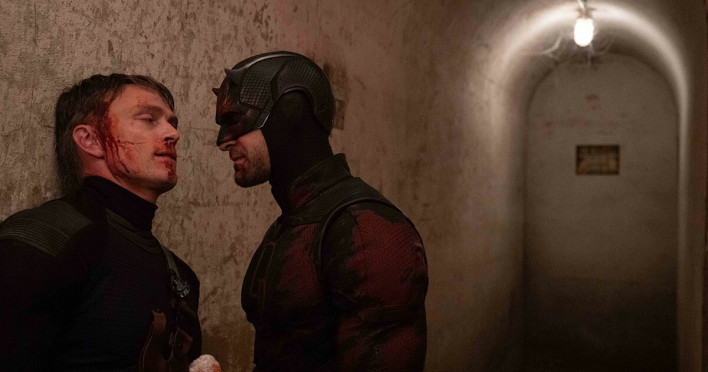
Episode 5, which explores Matt’s internal conflict and his answer through flashbacks of Foggy, is one of the most well-crafted episodes in any MCU series.
The thematic focus on Daredevil’s atonement and mercy stems from the comics, perfected by Frank Miller. Miller, who changed the paradigm of American superhero comics with Batman: The Dark Knight Returns and Alan Moore’s Watchmen, made Matt’s guilt the core driving force of the character. He endlessly poses the question: can the violence inherited from his father, which matches his overflowing sense of justice, be used for the sake of that justice.
If this is Matt’s internalized theological characterization, his outward goal is to save the world through mercy and forgiveness. This leads to his forgiveness of Poindexter, who killed Foggy Nelson. Murdock keeps Poindexter alive, dragging him along to the end. Saving Poindexter—who would have been taken by the Anti-Vigilante Task Force—is also an act of atonement for himself. He is saving the man he once almost killed. This balance is not merely about Matt’s guilt; it is elevated to a higher level through flashbacks of Foggy.
The flashbacks return to a time when Matt and Foggy were defending Ray, an acquaintance from Foggy’s childhood. Although Ray was clearly guilty and a plea deal was the most appropriate path, Matt and Foggy knew that if he went to prison, he would be murdered by Kingpin’s men. Matt still believes it is right for him to be punished by the law. However, Foggy goes beyond just preventing his indictment; he empties the firm’s funds, hands the money to Ray, and helps him flee. Mercy, forgiveness, and a second chance. Recalling this, Matt forgives and saves Poindexter.
Episode 5’s flashbacks weave together the story of Foggy and the past of Kingpin. It depicts the scene where Fisk first met Vanessa, and how Vanessa’s death becomes the catalyst for Fisk to lose even his humanity as mayor.
The Daredevil series has long left a deep impression with its spectacular, human-focused action, particularly its hallway fights and long-take sequences. However, Episode 5, devoid of such action, achieves a level of perfection through pure dramatic direction that makes it arguably the best episode in any MCU series.
If Episode 5 represents the pinnacle of traditional drama in the MCU, Episode 4 features an action sequence that ranks among the most impressive in MCU history. Poindexter falsely reports that Frank Castle (The Punisher) is at a diner, drawing out the Anti-Vigilante Task Force, and then proceeds to kill them with a smile. True to his ability to turn anything into a lethal weapon, he kills the task force members with straws, toothpicks, forks, knives, and even a lobster claw.
This action unfolds in slow motion to the backdrop of Billy Joel’s sweet ‘New York State of Mind.’ The sight of Poindexter, who calls himself a ‘good guy,’ drawing a Bullseye mark in ketchup before heading off to finish his work, is bizarre and chilling, yet evokes complex emotions. This is, in fact, the direction that best captures Poindexter.
As Poindexter says, he is the protagonist of his own journey; he genuinely believes his actions as a villain are the right ones. He does not treat his evil deeds as mere entertainment, nor does he attempt to justify them. His violence, which was evident from childhood and hidden during his time as an FBI agent, is unleashed under Kingpin, creating a point of connection with Matt.
However, Matt’s violence is tempered by a moral compass of faith and law, which Poindexter lacks. At the same time, there is a scene where Poindexter hides in a church, seeking mercy. It is as if we are seeing the Matt of the Netflix era. It implies that Poindexter might be who Matt would have become had he made slightly different choices. Matt’s act of saving Poindexter is an act of mercy toward the violence he has spent his life atoning for, and toward another sinner lost within that violence. This is why Poindexter, despite being a clear villain, is a three-dimensional character unlike typical antagonists.
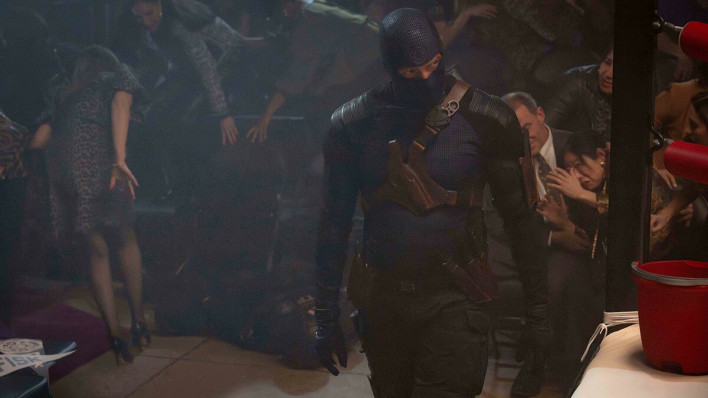
The final episode depicts the conflict between Matt and Fisk as the end for both characters as they exit the stage in New York. Matt, having put Fisk on the witness stand, summons Daredevil—the only witness who can prove Fisk’s crimes—to the court. He reveals his secret, saying, ‘I am Daredevil.’
This statement is the same expression Matt used 10 years ago when he revealed his identity to Karen (at the time, ‘I’m Daredevil’). While it can be interpreted as an homage to Iron Man’s ‘I am Iron Man’ press conference, it is more accurately a scene where Matt, having nothing left to lose, is finally honest with the one person remaining: Karen. Ten years later, revealing his identity to the citizens is more than just resolving a crisis; it is an act of sacrifice and liberation. Despite the criminal record he will bear once his identity is exposed, he seeks to prove that Fisk, too, is a person who exists under the law.
This leads to an uprising of the citizens. Fisk, having lost everything and become the Kingpin, ruthlessly suppresses the crowd attacking him in a narrow hallway. To be precise, he crushes them. It is drawn with the same menace as the scene in Rogue One: A Star Wars Story where Darth Vader suppresses the rebels with no escape. It reaffirms that Kingpin was Daredevil’s most formidable threat. However, unlike Vader’s ruthlessness, this scene is also a moment that symbolically reveals the rage of a Fisk who has lost everything.
But in the end, while he can suppress a dozen citizens, he falls when hundreds of protesters swarm him. Matt stops the crowd, giving him one last chance at mercy. Fisk has lost his beloved Vanessa, his mayorship, and the legal battle. He has lost to the crowd. To be precise, he has faced an opponent he cannot defeat. Fisk, who led people and manipulated public opinion with his unique leadership, had brought down many heroes by branding them vigilantes. Yet, he is brought down by the collective power of the ordinary citizens he had been crushing until moments ago.
Thus, Matt and Fisk exit the stage quietly, at the same time and in different ways. Fisk, who had already shaken the judicial system through legal loopholes, accepts an offer to go abroad and leaves New York. Matt, having revealed himself as Daredevil, is arrested by the police to serve time. Though their methods differed, it is a portrait of two individuals who loved New York most, exiting the stage. Daredevil, who stood at the forefront as a symbol for the citizens, is arrested, while Fisk, the man of power, disappears without an indictment. It ends on a bitter note, as if to say this is the unavoidable reality. This kind of ending is also something rarely seen in the MCU.
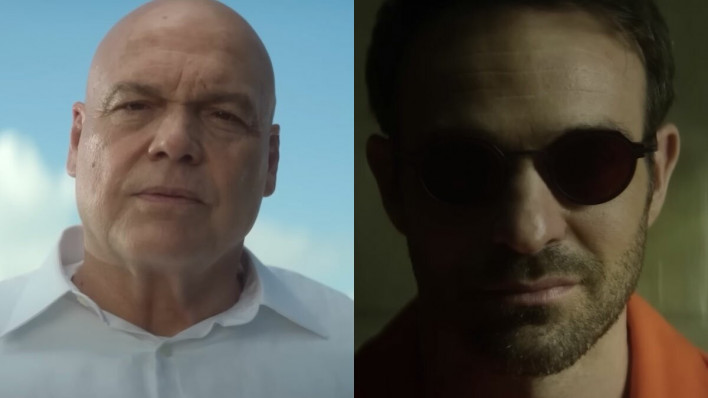
Daredevil: Born Again Season 2 has thus come to an end. However, with the mid-season addition of Jessica Jones, Brett Mahoney gaining more power as a detective sergeant, and Luke Cage returning to the Alias Investigations office in the finale, we can look forward to the combination of the Defenders characters and actors from the Netflix era. Furthermore, Frank Castle, who played a major role in Born Again Season 1, will tell his own story in the short film The Punisher: One Last Kill on the 12th.
The Punisher’s story continues into Spider-Man: Brand New Day. This work is also the final MCU film before Avengers: Doomsday, which will showcase a narrative and scale unlike anything seen before. The high level of completion shown by Daredevil: Born Again is enough to make us look forward to Marvel’s next chapter.
[Read Original]
PakarPBN
A Private Blog Network (PBN) is a collection of websites that are controlled by a single individual or organization and used primarily to build backlinks to a “money site” in order to influence its ranking in search engines such as Google. The core idea behind a PBN is based on the importance of backlinks in Google’s ranking algorithm. Since Google views backlinks as signals of authority and trust, some website owners attempt to artificially create these signals through a controlled network of sites.
In a typical PBN setup, the owner acquires expired or aged domains that already have existing authority, backlinks, and history. These domains are rebuilt with new content and hosted separately, often using different IP addresses, hosting providers, themes, and ownership details to make them appear unrelated. Within the content published on these sites, links are strategically placed that point to the main website the owner wants to rank higher. By doing this, the owner attempts to pass link equity (also known as “link juice”) from the PBN sites to the target website.
The purpose of a PBN is to give the impression that the target website is naturally earning links from multiple independent sources. If done effectively, this can temporarily improve keyword rankings, increase organic visibility, and drive more traffic from search results.


